Think of a business you know well. Chances are you can picture its colors before you picture its logo.
That is how powerful color is in branding. It shows up on your website, social media, packaging, business cards, and ads, and over time customers begin to connect those colors with your business.
But for a small business owner, choosing colors can feel more difficult than it sounds. You may like blue, your designer may suggest green, and a competitor may already be using red. How do you decide?
This guide walks through a practical process for choosing brand colors for a small business, plus the mistakes to avoid.
Why Brand Colors Matter
Colors do three jobs for your business:
- They help people recognize you. Consistent colors make your business easier to spot and remember.
- They set the tone. A calm blue palette feels different from a bold orange and black one.
- They keep your branding consistent. A fixed palette keeps your website, social posts, and print materials looking like they belong together.
Color alone will not build a brand. But the wrong or inconsistent colors can make a good business look disorganized.
Step 1: Start With Your Brand Personality
Before looking at color swatches, answer a few simple questions:
- Is your business modern, traditional, playful, or premium?
- Who are your customers, and what do they expect?
- How should people feel after seeing your brand?
A law firm and a children’s toy store should not feel the same. Your colors should match the personality you want to communicate.
Step 2: Understand Common Color Associations
Colors often carry associations, though they are not strict rules and can change by culture and context.
- Blue is commonly linked with trust, calm, and reliability.
- Red often suggests energy, urgency, or passion.
- Green is often connected with growth, health, and nature.
- Yellow and orange can feel warm, friendly, and optimistic.
- Black and deep neutrals often signal a premium or serious tone.
- Purple is sometimes linked with creativity or luxury.
Use these as a starting point, not a formula. A green logo will not automatically make a business feel eco-friendly if the rest of the design does not support it.
Step 3: Look at Your Competitors
Check which colors others in your industry use. If every competitor uses the same blue, you may want to avoid it, or use it in a different way.
The goal is not to be different for the sake of it. It is to be recognizable. If a customer could mistake your brand for a competitor’s at a glance, your colors are not doing their job.
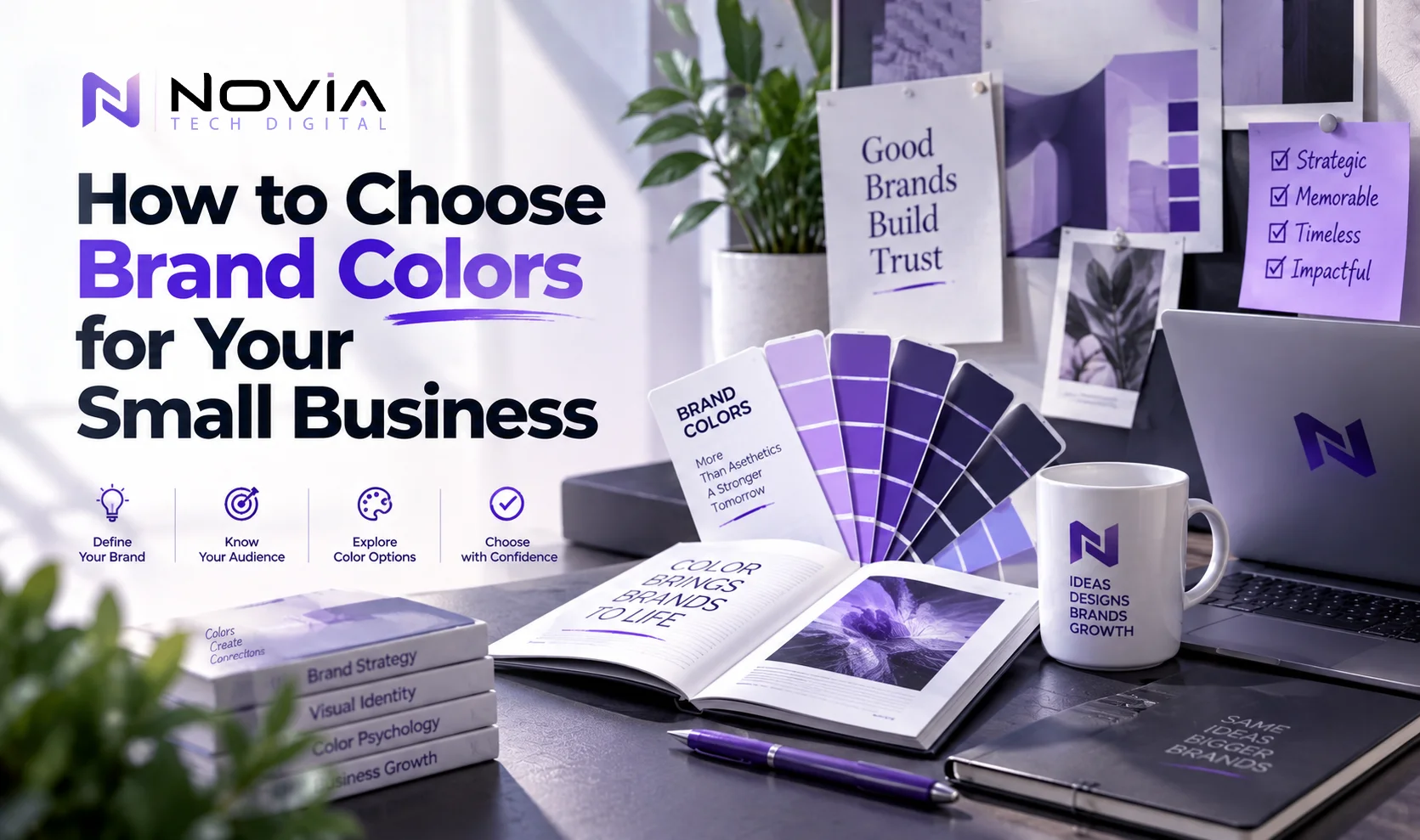
Step 4: Build a Simple Palette
Most small businesses do well with a palette of three to five colors:
- One primary color that represents your brand most strongly
- One or two secondary colors that support it
- Neutral colors such as white, off-white, gray, or black for backgrounds and text
- An optional accent color for buttons and highlights
A common guideline is to use one dominant color for most of the design, a supporting color for a smaller share, and an accent sparingly. It is not a strict rule, but it helps stop designs from looking crowded.
Step 5: Check Contrast and Readability
A beautiful palette is not useful if people cannot read your text. Light text on a light background, or bright colors placed against each other, can be difficult to read, especially on mobile screens.
Accessibility guidelines commonly recommend a contrast ratio of at least 4.5 to 1 for normal body text. Free contrast checker tools can test your color pairs in seconds. Do this before you finalize anything, because it also helps customers with low vision or color blindness.
Step 6: Test Your Colors in Real Places
Try your palette across everything your business will actually use:
- Website and buttons
- Social media profile and posts
- Business cards and printed materials
- Packaging or signage
- Light and dark backgrounds
Screen colors and printed colors can look different. This is because screens use RGB, while print uses CMYK. Ask your designer to prepare both versions so your colors look as close as possible everywhere.
Document Your Colors
Once you choose your palette, write it down. Record each color with its name and its HEX, RGB, and CMYK values. This becomes part of your brand guidelines, so everyone who works on your brand, from an in-house team to a freelancer, uses the exact same colors.
Common Brand Color Mistakes
- Using too many colors. More than five or six usually makes a brand feel messy.
- Following trends. A trendy palette can look dated quickly.
- Choosing only what you personally like. Your customers’ reactions matter more than your favorite color.
- Ignoring contrast. Pretty but unreadable is still unreadable.
- Using different shades in different places. A slightly different blue on every platform weakens recognition.
- Forgetting about print. Colors can change when they move from screen to paper.
Frequently Asked Questions
How many colors should a brand have?
Most small businesses do well with three to five colors, including neutrals.
Does color psychology really work?
Colors can influence mood and perception, but the effect depends on culture, context, and overall design. Treat it as guidance, not a guarantee.
Should I choose my logo or my colors first?
They usually develop together. Many designers pick a color direction while working on the logo, then expand it into a full palette.
Can I change my brand colors later?
Yes, but changing them means updating everything, so it is better to choose carefully the first time. A rebrand may be worth it if your colors no longer fit your business.
Do I need brand guidelines for colors?
It is a good idea. Even a simple one-page guide helps keep your branding consistent as your business grows.
Final Thoughts
Good brand colors are not about picking the most popular shade. They are about choosing a small, consistent palette that fits your business, works for your audience, and stays readable everywhere it appears.
If you would like help building a color palette and a complete visual identity, NoviaTech Digital can help through our branding services for small businesses. You can also read our guide to small business branding or contact us to start a conversation.